.svg)


Key takeaways
On this page


eciding on the best solar panels for home use involves more than just looking at the highest numbers. The top panels offer a blend of high efficiency, robust durability, and a strong warranty from a reliable company.
Finding the Best Solar Panels for Your Home
For a quick answer, here are the key traits and brands often considered top-tier for residential use:
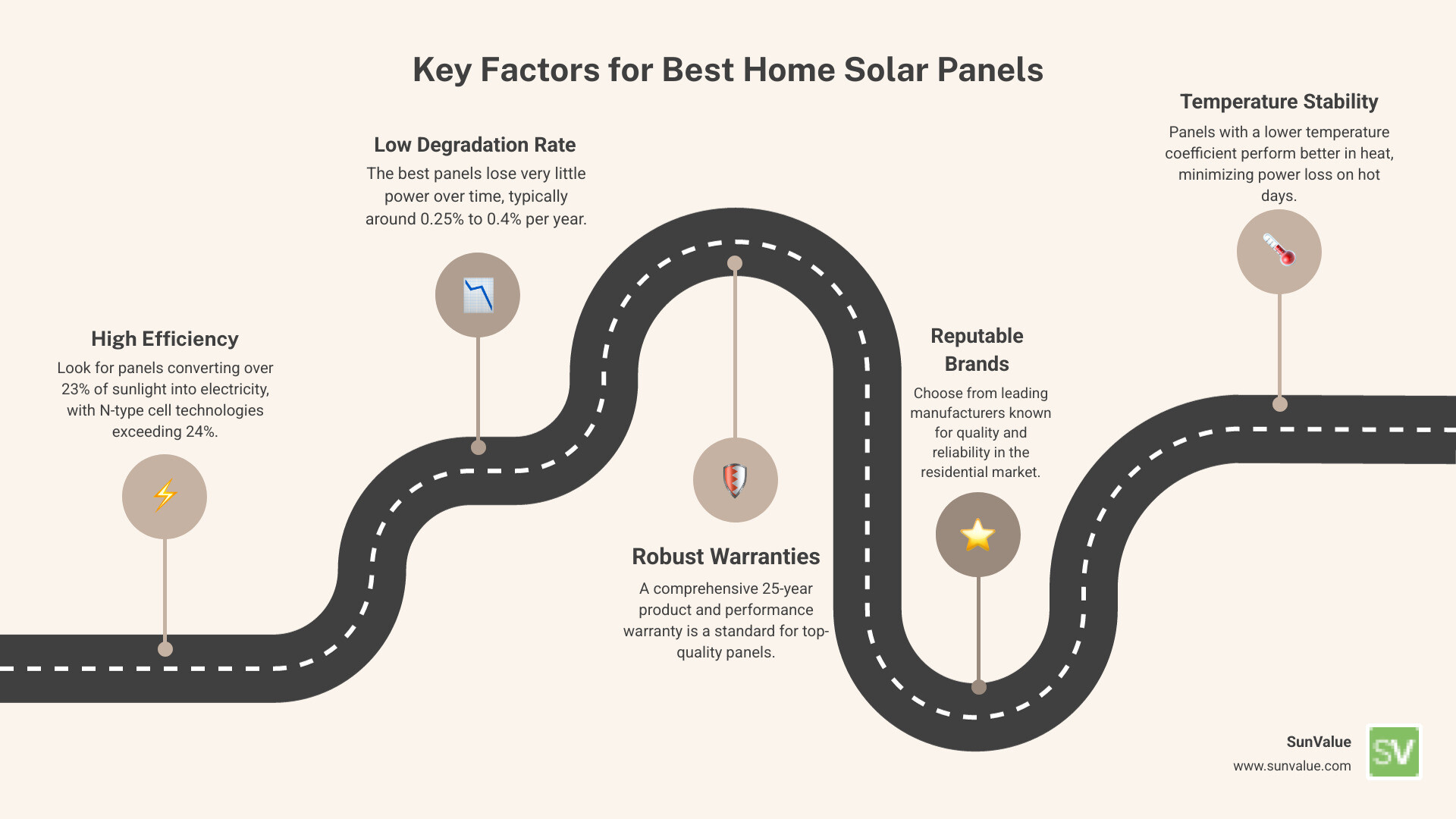
- High Efficiency: Look for panels converting over 23% of sunlight into electricity. Many N-type cell technologies (like TOPcon or HJT) now exceed 24%.
- Low Degradation Rate: The best panels lose very little power over time, typically around 0.25% to 0.4% per year, ensuring strong performance for decades.
- Strong Warranties: A comprehensive 25-year product and performance warranty is a standard for top-quality panels.
- Leading Brands: Companies frequently cited for their excellent residential panels include Maxeon (SunPower), Qcells, Longi, Jinko Solar, Canadian Solar, REC, and Panasonic.
Over the last decade, solar panel technology has advanced dramatically. Average efficiency has jumped from 15% to over 23%, and power ratings have soared from 250W to well over 450W for standard residential panels. This means more power from less space, making solar energy more accessible and effective for homeowners looking to cut energy bills and reduce their carbon footprint.
As Nina Golban, I've dedicated my career to helping homeowners steer the complexities of solar energy, ensuring they find the best solar panels for home use that align with their specific needs and goals. My expertise lies in simplifying complex solar concepts into clear, actionable advice.
Decoding Solar Panel Technology: A Homeowner's Guide
Before we dive into what makes the best solar panels for home use, let's take a moment to understand these incredible devices. At their heart, solar panels are truly modern marvels! They're specifically designed to capture sunlight and transform it into clean, usable electricity for your home. It all starts with tiny, powerful components called photovoltaic (PV) cells, which are usually crafted from silicon. Think of these cells as miniature sun-loving superheroes, arranged together to form what we commonly call a solar panel.
The journey from sunlight to the electricity powering your toaster is quite fascinating. When sunlight's tiny energy packets (photons) hit the silicon in those PV cells, they get electrons excited, making them move and create an electric current. This initial electricity is direct current (DC). Since your home appliances prefer alternating current (AC), this DC electricity then flows to a special device called an inverter, which handles the change. Voila! Instant power for your home. If you're curious to learn more about this magic, our guide on What Are Photovoltaic Solar Panels? offers a deeper dive.
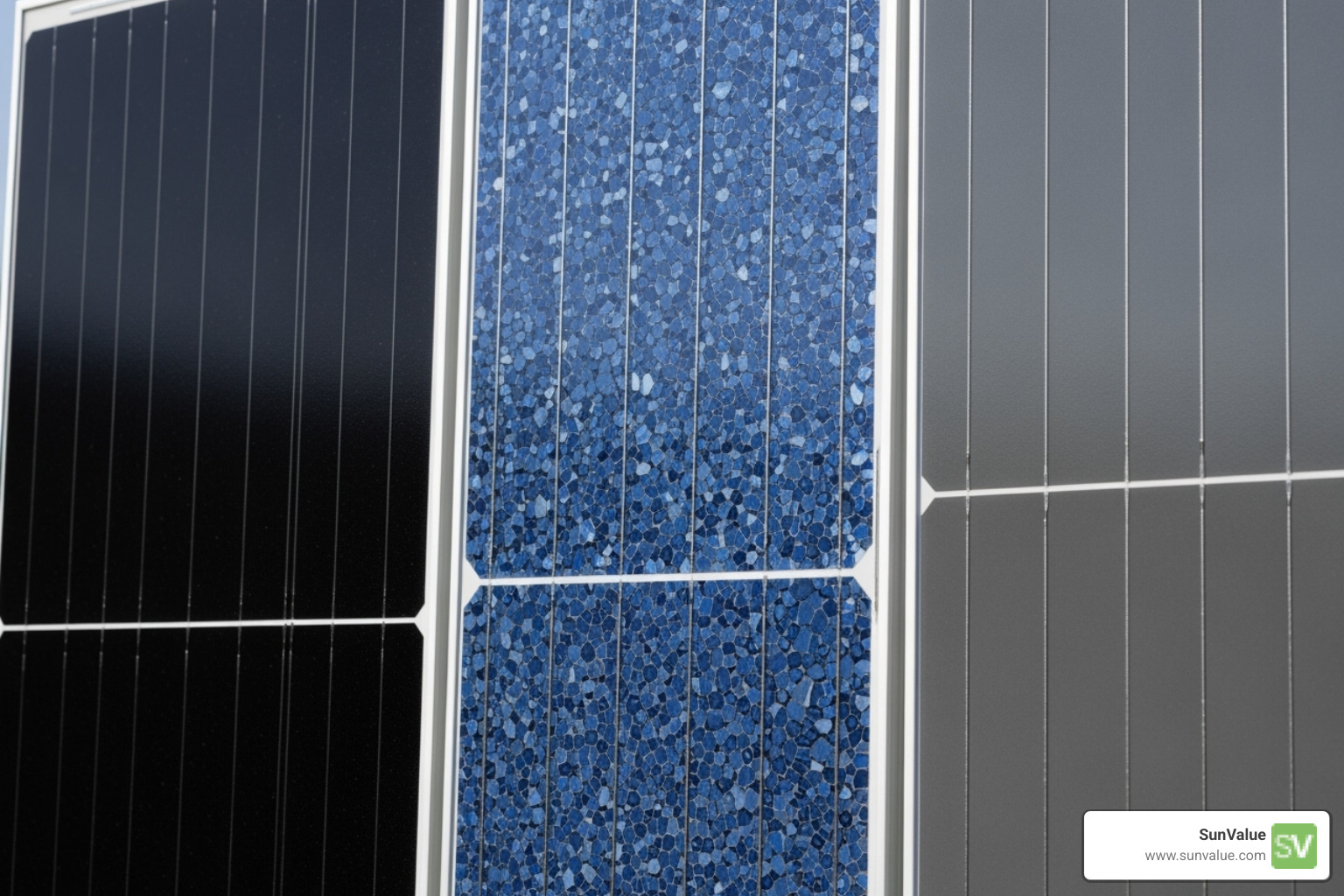
Over the years, solar technology has evolved, giving us a few different types of panels. Each has its own unique strengths when it comes to efficiency, cost, and how long they last. Let's break down the main players you might encounter.
Monocrystalline Solar Panels
If you've ever admired a modern solar installation, chances are you were looking at monocrystalline panels. These are often seen as the gold standard for residential solar because they're super efficient and boast a sleek, uniform black look. They're made from a single, pure crystal of silicon, which means electrons have a super-smooth highway to travel on. This leads to higher efficiency rates, allowing them to generate more power from a smaller area. That's a huge plus for homes with limited roof space!
While they might have a slightly higher upfront cost, their superior performance often translates into bigger savings over the long run. In fact, most residential solar panels installed today are monocrystalline. The industry has largely moved towards these advanced, reliable options. For a closer look at how they stack up against another type, check out our article on Monocrystalline Solar Panel vs Polycrystalline.
Polycrystalline Solar Panels
You might recognize polycrystalline panels by their distinctive blue, speckled appearance. These panels were quite common in the past. Unlike their monocrystalline cousins, they're made by melting multiple silicon fragments together. This manufacturing process is generally less expensive, making polycrystalline panels a more budget-friendly choice.
However, there's a trade-off: lower efficiency. The many silicon crystals create more "traffic jams" for electrons, which means less overall power conversion. Because they're less efficient and need more space to generate the same amount of power, they're now rarely sold for new residential installations. They represent an older technology, and most leading manufacturers have since focused on more advanced, efficient options. You can learn even more about the various panel types in our guide on Solar Panels Types.
Thin-Film Solar Panels
Thin-film solar panels are a bit like the unique artists of the solar world. Instead of thick silicon wafers, they use incredibly thin layers of special photovoltaic material, like amorphous silicon or cadmium telluride, applied onto a surface. What makes them stand out? They're often flexible, super lightweight, and can even be transparent!
Their biggest advantages are their adaptability and, in some cases, lower cost per watt. However, they typically have the lowest efficiency ratings among the main types, usually ranging from 9% to 18%. This means you'd need a much, much larger area to produce the same amount of electricity as monocrystalline panels. Because of this, thin-film panels usually aren't the best solar panels for home use on a typical rooftop where space is precious. Instead, they shine in specialized roles, like large-scale utility projects, powering RVs, boats, or other small setups where flexibility and light weight are more important than raw power density. For a glimpse into another innovative, flexible solar solution, you might enjoy exploring Solar Shingles in 2025: Worth the Buzz?.
Beyond Efficiency: What Truly Makes a Solar Panel 'Best'?
Here's the thing about finding the best solar panels for home use - efficiency gets all the attention, but it's just one piece of a much bigger puzzle. Think of it like buying a car. You wouldn't choose one based solely on horsepower, right? You'd consider fuel economy, reliability, warranty, and how it looks in your driveway.
The same goes for solar panels. The truly best panel for your home creates a perfect balance of performance, durability, warranty coverage, and even curb appeal to deliver maximum value over its 25-30 year lifespan. It's about playing the long game, not just chasing the highest number on a spec sheet.
Let's explore the key performance metrics that separate good panels from great ones. For a broader understanding of how efficiency fits into the bigger picture, check out Are Solar Panels Efficient?.
Understanding Solar Panel Efficiency
Solar panel efficiency is basically your panel's report card - it tells you how much of the sunlight hitting your roof actually gets converted into usable electricity. If a panel has 20% efficiency, it's turning one-fifth of that sunshine into power for your home.
The solar industry has been on an absolute tear lately. Average panel efficiency has jumped from a modest 15% just a decade ago to over 23% today. The best solar panels for home use now routinely exceed 24% efficiency, with some pushing even higher.
This magic happens under Standard Test Conditions (STC) - think of it as the solar panel equivalent of a controlled laboratory environment. Scientists test panels at exactly 25 degrees C (77 degrees F), with 1000W/sq m of solar irradiance, and specific atmospheric conditions. While your roof will never match these perfect conditions, STC gives us a fair way to compare different panels.
The real stars of today's efficiency gains are N-type cells, particularly technologies like TOPcon, Heterojunction (HJT), and Back-Contact (IBC) cells. These aren't just fancy names - they represent genuine breakthroughs that push panels well above 24% efficiency. Some cutting-edge panels are even hitting 24.7% efficiency, which would have been science fiction just a few years ago.
But here's where it gets interesting. Your actual power output depends on real-world conditions that can vary dramatically. Shading from that big oak tree can slash your production, even if it only covers part of one panel. Temperature swings throughout the day affect performance. The angle and direction your roof faces determines how much sun your panels actually catch. Even weather patterns and seasonal changes play a role.
For a deeper dive into these calculations and measurements, our guide on Solar Panel Energy Efficiency breaks it all down.
The Temperature Coefficient: Performance in the Heat
Here's something that surprises most homeowners - solar panels actually hate extreme heat. I know, it sounds backwards. They need sun, but when that Arizona summer pushes temperatures into triple digits, your panels start getting a bit cranky.
This is where the temperature coefficient becomes your best friend. This number, shown as a percentage per degree Celsius (%/degrees C), tells you exactly how much power your panels lose when they get too hot. A panel with a -0.40%/degrees C coefficient loses nearly half a percent of its power for every degree above 25 degrees C.
Now, here's the kicker - your panels typically run 20-30 degrees C hotter than the air temperature. So on a 95 degrees F day, your panels might be running at 115 degrees F internally. That can mean 8-15% less power than those perfect lab conditions would suggest.
For anyone living in warmer climates, hunting down panels with lower temperature coefficients is absolutely crucial. The newest N-Type HJT (heterojunction) cells are crushing it in this department, with coefficients around -0.25% to -0.27%/degrees C. They're like that friend who stays cool under pressure - literally.
Want to crunch the numbers yourself? Check out How to Calculate Solar Panel Efficiency for the full breakdown.
Degradation Rate and Durability
Solar panels are built like tanks, designed to keep cranking out electricity for 25 to 30 years. But even the toughest equipment ages, and solar panels gradually lose a tiny bit of their punch each year. This is called the degradation rate.
The industry standard sits around 0.4% annual degradation. That means after 25 years, your panels might still produce about 86% of their original power - not too shabby for quarter-century-old technology.
But the best solar panels for home use do much better than average. High-quality N-type cells often degrade at just 0.25% per year, thanks to their superior resistance to Light-Induced Degradation (LID). Over 25 years, that difference adds up to thousands of extra kilowatt-hours and real money in your pocket.
Durability goes way beyond just power degradation. Your panels need to laugh off hailstorms, heavy snow loads, hurricane-force winds, and temperature swings that would make a lesser product cry for mercy. The top manufacturers put their panels through rigorous testing to meet strict certifications, ensuring your investment stays protected through whatever Mother Nature throws at it.
Understanding the Life of a Solar Panel and how Solar Panel Efficiency Over Time impacts your long-term savings is key to making the right choice.
Power Output (Wattage)
Power output, measured in watts, tells you how much electricity each panel can pump out under those perfect lab conditions we talked about earlier. It's been an incredible decade for power ratings - we've gone from 250W panels to monsters pushing over 450W, with some commercial panels even breaking 700W.
Higher wattage generally means more electricity, but context matters. A 450W panel might be physically larger than a 400W panel. However, if that 450W panel is also more efficient, it's producing more power per square foot of your precious roof real estate.
This becomes critical when your roof space is limited. Maximizing energy generation within your available space is the name of the game. You want to build the optimal system capacity that fits your roof and meets your energy needs.
Curious about what kind of energy production you can expect? Our guide on How Much Energy Solar Panels Produce will help you plan your system size and understand what to expect from your investment.
How to Choose the Best Solar Panels for Home Use
Choosing the best solar panels for home use is a significant decision, much like choosing a new car or planning a major home renovation. It's a long-term investment that will power your home for decades, so it's worth taking the time to get it right! It's not just about picking the most powerful panel or the cheapest option; it's about making an informed choice that truly fits your energy needs, your budget, and your goals for a sustainable future. We want to empower you to make a choice you'll be happy with for decades to come. To get started on this exciting journey, our guide on How to Choose Solar Panels offers a great initial roadmap.

Evaluating Warranties: Your 25-Year Safety Net
Think of a solar panel warranty as your long-term safety net, protecting your investment for a quarter-century or more! This is incredibly important because you're installing a system meant to last. There are typically two main types of warranties you'll want to understand:
First, there's the Product Warranty. This is your assurance against any defects in how the panel was made, its materials, or the workmanship. Most top-tier solar panels come with a product warranty ranging from 12 to 25 years. Some brands, like SEG Solar, even go above and beyond with a 30-year product warranty, while Jinko Solar offers 25 years and JA Solar offers 12 years. This means if the physical panel itself decides to stop working prematurely due to a manufacturing flaw, it will be replaced or repaired.
Second, and equally important, is the Performance Warranty. This guarantees that your panels will continue to produce a certain percentage of their original power output over time. For instance, a common promise is that your panels will still deliver at least 90% of their original output after 10 years and 80% after 25 years. However, the best solar panels for home use offer much better. Qcells, for example, boasts a 90.58% production guarantee over 25 years for some models, and Panasonic and REC Group stand out with a super low annual degradation rate of just 0.25% in their performance warranty. This directly impacts how much electricity (and savings!) you'll get over your system's lifetime.
Beyond these, some solar installers offer a labor or workmanship warranty, which covers the actual installation process itself. Always remember to read the fine print! A warranty is only as good as the company standing firmly behind it. This leads us to our next critical point for choosing wisely. For a comprehensive look at what makes panels truly reliable, checking out The Most Reliable Solar Panels of 2024 is a smart move.
Why Manufacturer Reputation (Bankability) Matters
Imagine buying a product with a fantastic warranty, only to find the company has vanished when you need to use it. That's why choosing a solar panel from a reputable, financially stable manufacturer is absolutely crucial! This important concept is often called "bankability." Why does it matter so much? Because if a manufacturer goes out of business, their warranty might become worthless, leaving you in a tricky spot.
When we talk about "Tier-1" manufacturers, we're generally referring to the cream of the crop. These are companies that have been around for a long time, have strong financial health, pour resources into research and development to innovate, and use highly automated manufacturing processes. These are the companies most likely to honor their warranties for the entire lifespan of your solar system. They've built trust through consistent quality and reliable performance.
Brands like Canadian Solar (ranked #1 by SolarReviews for 2025), JA Solar, Qcells, Silfab, Jinko Solar, Panasonic, REC, Trina Solar, SEG Solar, and LONGi are consistently recognized as top-tier manufacturers. These companies have proven track records, solid financial performance, and a deep commitment to quality that truly gives homeowners peace of mind. For a comprehensive guide on comparing manufacturers and understanding who stands out, dive into Comparing Solar Panel Manufacturers: A Guide.
Conclusion: Powering Your Future with the Right Choice
Alright, we've journeyed through the sunny world of solar panels, from understanding the tiny cells that make it all happen to diving deep into what really makes a panel shine. Choosing the best solar panels for home use isn't about finding a single "perfect" panel. Instead, it's about making a smart, informed decision that brings together several key ingredients.
Think of it like baking a perfect cake. You need the right mix of efficiency (how much sunlight converts to power), a good temperature coefficient (how well it handles the summer heat), a low degradation rate (how little power it loses over time), and solid wattage (how much energy it generates). But just as important are the layers of trust: a strong product and performance warranty that acts as your long-term safety net, and a manufacturer with a rock-solid reputation and financial stability. And let's not forget aesthetics - after all, these panels will be a prominent feature on your home!
Even the most impressive solar panels need an expert touch. The quality of your installer is just as vital as the panels themselves. A great installer ensures your system is designed perfectly, installed safely, and performs optimally for years to come.
So, is all this effort worth it? Is It Worth Installing Solar Panels? Absolutely! Investing in solar is more than just cutting your electricity bills; it's about building a more sustainable, independent future for your home and family. It's a choice that pays dividends for decades.
At SunValue, we're passionate about making this journey easy and clear for you. We understand that every home is unique, and so are its energy needs. That's why we provide instant, competitive quotes and a clear savings analysis. Our goal is to empower you with all the information you need to confidently choose the best solar panels for home use and kickstart your solar trip. Ready to light up your future with clean, renewable energy? Get a personalized quote for your residential solar panels today!
Related
What are the best solar panels for home use in 2025?
The best panels in 2025 combine high efficiency (23–24.7%), low degradation rates, and long warranties. Leading models include Maxeon 7, REC Alpha Pure-R, Panasonic EverVolt, Qcells Q.TRON, and Jinko Tiger Neo N‑Type TOPCon panels.

Is high efficiency worth paying for in 2025?
Yes—particularly for homes with limited roof space, high electricity bills, or shading issues. Higher‑efficiency panels produce more power per square foot and often deliver a faster ROI, even at a higher upfront price.
Is high efficiency worth paying for in 2025?
Yes—particularly for homes with limited roof space, high electricity bills, or shading issues. Higher‑efficiency panels produce more power per square foot and often deliver a faster ROI, even at a higher upfront price.
What wattage panels are recommended for homes in 2025?
The new residential standard is 420W–460W per panel, with high-end panels exceeding 475W. These higher wattages reduce installation costs and maximize power production on smaller roofs.
Which is more important—efficiency, warranty, or degradation rate?
All matter, but in 2025 the priority ranking is:
- Degradation rate – impacts 25–40 year lifetime power
- Warranty – shows manufacturer confidence & protects investment
- Efficiency – helps maximize limited space but isn’t the sole factor
Key takeaways
More from
Solar News
category


