.svg)


Key takeaways
On this page


re you a Florida homeowner looking to cut high electricity bills and accept clean energy? Understanding florida solar power incentives is your first step. The Sunshine State boasts 237 sunny days annually, making it a prime location for solar energy and ranking it third nationally for installations.
Opening up Solar Savings in Florida
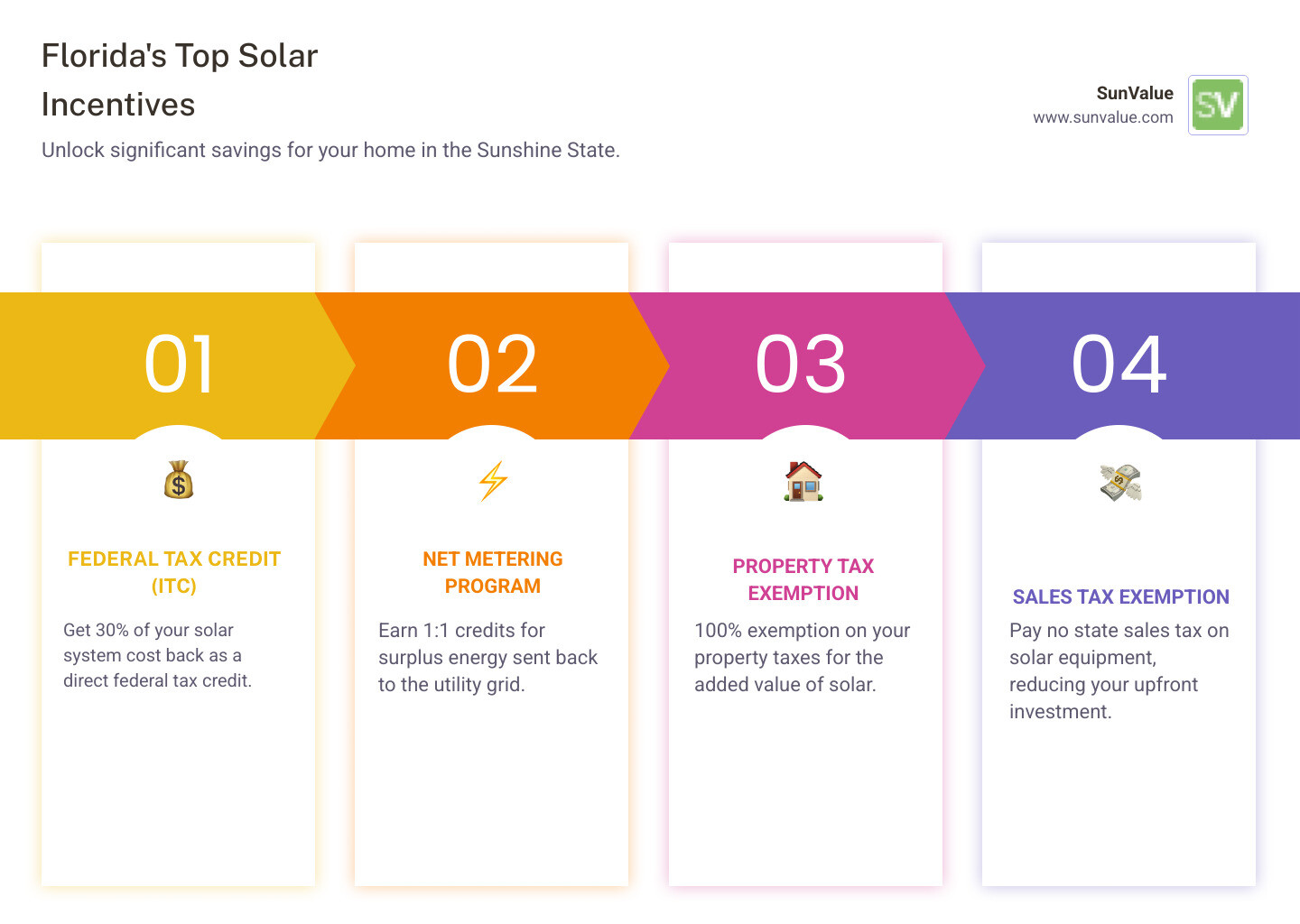
Here are the main solar power incentives available to Florida residents:
- Federal Solar Tax Credit (ITC): Save 30% on your solar system costs.
- Net Metering: Get credits for excess energy you send back to the grid.
- Property Tax Exemption: Your property taxes won't increase due to solar.
- Sales Tax Exemption: No state sales tax on solar equipment.
- Local & Utility Incentives: Explore programs offered by your city or utility company.
This guide will break down each benefit to show you how to maximize your savings.
My name is Nina Golban. As an expert in florida solar power incentives at SunValue, I create data-driven guides to help homeowners steer complex regulations and maximize their solar investment. Let's explore how these incentives can benefit you.
The Federal Solar Tax Credit: Your Biggest Saving
The biggest single saving for solar in Florida is the federal solar tax credit, also known as the Residential Clean Energy Credit (formerly the ITC). This powerful program allows homeowners to deduct a significant portion of their solar system's cost directly from their federal income taxes.
Currently, you can save 30% of your total system costs for systems installed before the end of 2032. This is a dollar-for-dollar reduction of your tax liability, not just a deduction. This generous credit was extended by the Inflation Reduction Act, making now an excellent time to invest in solar.
To qualify, you must own your solar energy system, either by paying cash or financing it with a solar loan. If you lease your panels or have a Power Purchase Agreement (PPA), the system owner, not you, claims the credit.
This tax credit rate will not last forever. It is scheduled to step down as follows:
- 30% for systems installed through the end of 2032
- 26% for systems installed in 2033
- 22% for systems installed in 2034
- It's scheduled to end in 2035, unless Congress decides to renew it.
This schedule means the sooner you switch to solar, the more you can save. Navigating tax rules can feel complex, but securing this saving is worth the effort.
For a deeper dive into federal solar incentives, check out our guide on Federal Solar Incentives. You can also learn more in our article on Solar Energy Tax Credits.
How the ITC Works for Floridians
Claiming the ITC in Florida is straightforward. Here’s how it works:
Eligibility: You must own your system (via cash or loan) and the home must be your primary or secondary residence in the U.S.
Calculating Your Credit: The credit is 30% of the total system cost, including equipment, installation labor, and permitting fees. For an average $10,548 5 kW system in Florida, the ITC provides a $3,164.40 credit ($10,548 x 0.30).
Claiming on Taxes: You claim the credit when you file your federal income taxes using IRS Form 5695, "Residential Clean Energy Credit."
Rollover: If your tax liability is too low to use the full credit in one year, you can roll the remaining amount over to future tax years.
We always recommend consulting a qualified tax professional for personalized advice to maximize your savings.
What's Covered by the Federal Tax Credit?
The ITC covers more than just the panels. It includes a wide range of costs associated with your home solar system. Eligible costs include:
- Solar PV panels
- Solar batteries (great for hurricane season backup)
- Labor costs for installation
- Permitting and inspection fees
- Sales tax on equipment
Essentially, most costs for getting your system operational are eligible for the 30% credit, making the investment more manageable.
To understand more about government incentives, take a look at our guide on Government Incentives for Solar.
Key Florida Solar Power Incentives
Beyond the federal tax credit, Florida's state-level benefits make it a prime location for solar. With 237 sunny days per year (compared to the national average of 205), the solar potential is immense.
The average Florida household uses 1,142 kWh of electricity monthly—far more than the national average of 881 kWh—leading to high bills. This high consumption is precisely why florida solar power incentives are so effective.
Combining state policies with abundant sunshine, the average homeowner saves $40,676 in energy bills over the system's lifetime. Solar also increases home value by about 4.1% (around $16,039 for a typical Florida home valued at $391,213).
These incentives provide energy independence and protection from rising electricity rates. For a complete breakdown, check our guide on Solar Incentives and Rebates. To dive deeper into Florida's solar potential, our Solar Energy in Florida article has the details.
Florida's Favorable Net Metering Program
Florida's net metering program is a major benefit. When your panels produce more electricity than you use, the excess energy flows back to the grid.

You receive a 1:1 retail rate credit for this excess power, meaning you're credited at the same rate you pay for electricity. Your meter effectively runs backward.
These credits reduce your monthly bills. At the end of the year, leftover credits may be paid out, but the primary value is offsetting usage at the full retail rate.
Major utilities like Florida Power & Light (FPL), Duke Energy Florida, and Tampa Electric Company (TECO) all participate. The program is straightforward, with minimal red tape.
Want to see how much you could save? Our article Do Solar Panels Save Money breaks down the numbers.
Property Tax Exemption for Solar Systems
A fantastic Florida incentive is the property tax exemption: when you install solar, your home value increases, but your property taxes do not.
Solar adds an average of 4.1% to a home's value in Florida. Unlike in other states, Florida provides a 100% property tax exemption on this added value from residential solar and battery storage systems.
This exemption is in place through December 2037, offering a rare win-win of increased home value without the tax burden.
Solar and CHP Sales Tax Exemption
Florida also offers a 6% sales tax exemption on solar components and systems, a policy in place since 2005.
This 6% savings directly reduces your upfront equipment costs. To qualify, the equipment must be certified by the Florida Solar Energy Center (FSEC).
This exemption, combined with the federal tax credit, significantly lowers your initial investment and makes clean energy more accessible.
Local and Utility-Specific Solar Programs
While Florida lacks a statewide rebate program, many cities and utility companies offer their own local florida solar power incentives. These programs can include grants, low-interest loans, or rebates for solar and energy-efficiency upgrades.
These local incentives are often first-come, first-served with limited funding, so it's wise to check with your municipality and utility provider early. Whether you're looking into Solar Panel in Miami or Orlando Solar Panels, unique local programs may be available.
Local Solar Rebates and Grants
The variety of local programs shows how communities are embracing solar. Here are some examples of past and current programs:
- Boynton Beach Energy Edge Rebate Program - offered a $1,500 rebate for solar system installations of 5 kW or larger.
- Dunedin Solar Energy Rebate Grant Program - allowed homeowners to apply for a grant of $0.25 per watt, with a maximum rebate of up to $2,500.
- Lakeland Electric's Battery Incentive Program - offered a 50% rebate, up to $1,000, for battery storage with at least 6 kWh of usable capacity and a 10-year warranty.
- Jacksonville Electric Authority (JEA) - has offered battery installation incentives, with programs providing up to $4,000.
These examples show how local initiatives can provide valuable aid. Always check directly with your city and utility for current program information.
Finding Local Loan Programs
Beyond rebates, several loan programs make solar more accessible in Florida, often with favorable terms and little to no upfront cost.
Property Assessed Clean Energy (PACE) Financing allows homeowners to finance solar through an assessment on their property tax bill. This means no upfront costs, with repayments spread over 10-20 years. The loan is tied to the property, not the owner, and can transfer upon sale (though some lenders may require payoff). Qualification typically requires at least 10% home equity and a good tax payment history.
Another resource is the Solar and Energy Loan Fund (SELF), a non-profit offering low-interest loans (typically 5-9.5%) for energy improvements, including solar. Loans start at $1,000, and a credit score of 500+ is usually required.
Some utilities offer their own loan programs. For example, the City of Tallahassee Utilities has offered 5% fixed-rate loans up to $20,000 for solar PV. The Florida Keys Electric Cooperative has provided loans up to $35,000 for solar and battery systems with terms up to 10 years.
These programs, along with traditional solar loans, offer flexible financing that preserves your eligibility for the federal tax credit. We can help you explore Loans for Solar Panels to find the best fit for you.
The Financials: Cost, Payback, and ROI in Florida
Understanding the financials of solar in Florida involves looking at costs, savings, and the payback period. The state's unique energy landscape makes solar a smart financial decision.
Florida's typical electricity consumption is high at 1,142 kWh per month (US average is 881 kWh), leading to average monthly bills of $171.07. This high usage means greater potential savings from solar, as you offset more of your own power needs.
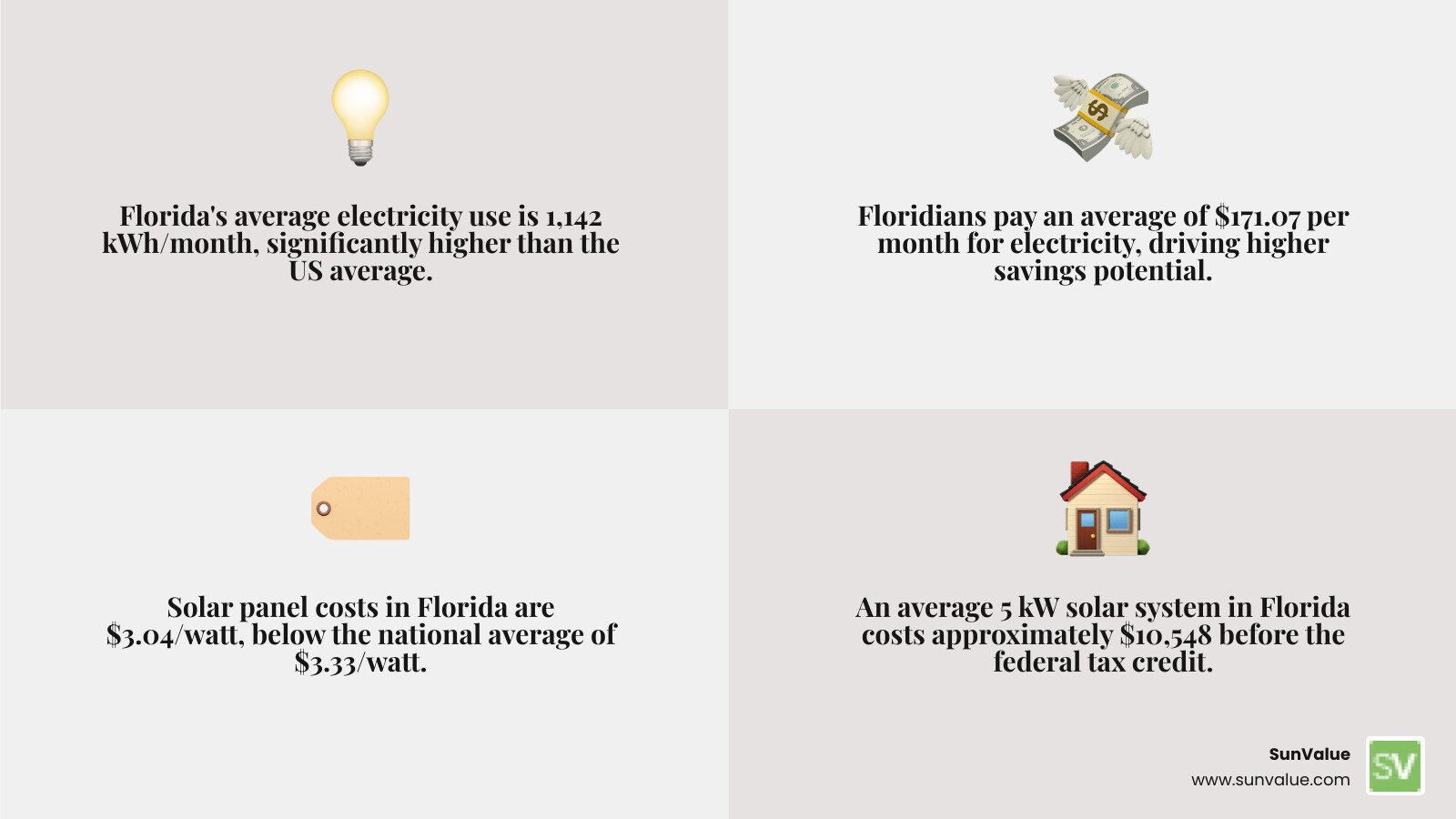
The cost of solar in Florida is competitive, at around $3.04 per watt, below the national average of $3.33. This lower cost, combined with abundant sunshine, creates an attractive return on investment (ROI). Learn more in our Solar Panels Cost guide.
Average Solar Cost and Lifetime Savings
The average cost for a 5 kW solar system in Florida is about $10,548 before applying the 30% federal ITC and other florida solar power incentives, which significantly lower the net cost.
Over the system's lifespan, the average Florida homeowner saves an estimated $40,676 on energy bills. This substantial ROI is based on real-world data from Florida's sunny climate.
Going solar is a robust financial strategy. The initial investment, offset by incentives, yields impressive long-term savings. Find out if Are Solar Panels Worth It for you with our personalized analyses.
Calculating Your Solar Payback Period
The payback period is the time it takes for savings to cover the initial cost. In Florida, the average is 11 years (ranging from 8-14). With panels warrantied for 25+ years, you'll enjoy many years of free electricity after the payback period.
Your payback period depends on several factors:
- System Size: A larger system may cost more but generate greater savings.
- Energy Usage: Higher consumption leads to faster payback.
- Electricity Rates: Higher or rising rates shorten the payback period.
- Incentives Used: Maximizing incentives reduces your net cost and payback time.
Learn more about the financial aspects in our detailed article: Pros and Cons of Solar Energy.
How financing affects your Florida solar power incentives
The way you finance your system impacts your eligibility for the federal ITC. Choosing the right method is crucial for maximizing savings.
- Cash Purchase: Paying with cash is the most straightforward path to ownership. You are fully eligible for the 30% federal ITC and benefit immediately from electricity savings.
- Solar Loan: Financing with a solar or home equity loan also makes you eligible for the federal ITC, as you own the system. Loan payments can replace your utility bill, and after it's paid off, your electricity is free.
- Solar Lease or Power Purchase Agreement (PPA): With a lease or PPA, you don't own the panels. The installation company claims the financial incentives, including the ITC. While your monthly bill may be lower, you miss out on the long-term financial benefits and home value increase of ownership.
It's also important to note a specific point for Florida: Power Purchase Agreements (PPAs) are prohibited in Florida by state law. This simplifies the decision, as the primary choices for ownership-based incentives are cash purchase or solar loans. We advocate for ownership to ensure you reap the maximum financial rewards.
Frequently Asked Questions about Florida Solar Incentives
Here are answers to some of the most common questions we receive about florida solar power incentives.
Are there any state-level solar tax credits or rebates in Florida?
No, Florida does not have a state-level income tax credit or a statewide rebate program for solar. However, the state offers powerful financial incentives through its policies, including a 100% property tax exemption, a state sales tax exemption, and a favorable net metering policy. These significantly reduce costs and increase savings. Always check with your local city and utility for specific grants, loans, or rebates.
Is going solar in Florida a worthwhile investment?
Yes, going solar in Florida is an excellent investment. The state's 237 sunny days per year provide a perfect environment for solar generation. The combination of the 30% federal tax credit, state tax exemptions, and net metering creates a powerful financial package. High electricity usage in Florida means greater potential savings, with an average homeowner saving over $40,000 in energy bills over the system's lifespan. Solar also boosts home value by about 4.1% without increasing property taxes. With an average payback of 11 years and panels lasting 25+ years, you gain energy independence and enjoy decades of free, clean electricity.
What should I be cautious about when considering solar in Florida?
While solar in Florida is a great opportunity, it's wise to be cautious. Here are a few things to keep in mind:
First, be wary of "free solar panels" scams. These are usually misleading ads for leases or rental agreements where you don't own the panels and thus don't qualify for the federal tax credit and other ownership incentives.
Second, research your installer. The booming industry has attracted some less-than-reputable companies. Choose a licensed, insured installer with a strong track record and positive reviews to avoid poor installations or misleading sales tactics.
Third, fully understand PACE loan terms. While a good option for some, the loan is tied to your property and can complicate a future sale. Read the fine print and understand all implications.
Finally, be aware that policies can change. Stay informed about potential legislative changes to incentives like net metering. Always perform due diligence by getting multiple quotes and comparing savings analyses. A reputable company like SunValue provides transparent quotes and a clear understanding of your savings. For help, see our guide on the Best Solar Panel Companies.
Conclusion: Capitalize on Florida's Solar Boom
In conclusion, Florida is a solar powerhouse. The combination of abundant sunshine, smart state policies, and generous incentives makes going solar an excellent financial decision.
You get a 30% federal tax credit, lucrative net metering, and property and sales tax exemptions. Combined with local programs, these incentives create a recipe for significant savings.
The numbers are compelling: average lifetime savings of over $40,000, an added home value of around $16,000, and an 11-year average payback period. After that, you get over a decade of free electricity from panels warrantied for 25+ years.
At SunValue, we help Florida homeowners steer these incentives with instant, competitive quotes and detailed savings analyses. We make the decision to go solar clear and straightforward, helping families cut their bills and contribute to a cleaner environment.
The timing is excellent. The 30% federal tax credit is available through 2032, and Florida's policies are strong. However, local programs can be limited, and the federal credit will eventually decrease.
Don't miss this opportunity. Florida's solar power incentives, sunshine, and high energy usage create the perfect conditions for solar savings. Going solar in Florida delivers financial, environmental, and energy independence benefits.

Ready to see what solar can do for your specific situation? We're here to help you take that next step with confidence. For even more insights into maximizing your solar investment, explore our comprehensive resource: The Ultimate Guide to Solar Incentives in 2025.
Your solar-powered future in the Sunshine State awaits!
Related
What solar incentives are available in Florida in 2025?
Floridians can benefit from the 30% federal solar tax credit, net metering, property tax exemptions, sales tax exemptions, and various local utility rebates or loans.

How much can I save by going solar in Florida?
The average Florida homeowner saves approximately $40,676 in energy costs over 25 years. Payback periods average around 11 years, with decades of free energy after.
Is there a state tax credit for solar in Florida?
No state income tax credit exists in Florida, but residents benefit from property and sales tax exemptions, plus utility-specific programs and net metering.
Can I get solar financing in Florida without upfront costs?
Yes, options like PACE loans and the SELF program offer low- or no-money-down financing for solar with flexible repayment terms and eligibility for tax credits.
Are solar leases or PPAs allowed in Florida?
No, Power Purchase Agreements (PPAs) are not allowed in Florida. Solar ownership (via cash or loan) is the best path to claim all available solar incentives.
Key takeaways
More from
Incentives and Savings
category


